

Hello, friends.
Our 11-month old puppy got very, very sick this month with what turned out to be meningitis. It’s been a long few weeks of e-vet visits, tests, and an unbelievable amount of drugs. (Thank god for pet insurance. Thank god for vets!) We were not at all certain she’d make it and still don’t know the underlying cause but things have stabilized a bit. As I type this, both dogs are snuggled up next to me, snoring away. But if you have some good energy to spare, Margie could use it.
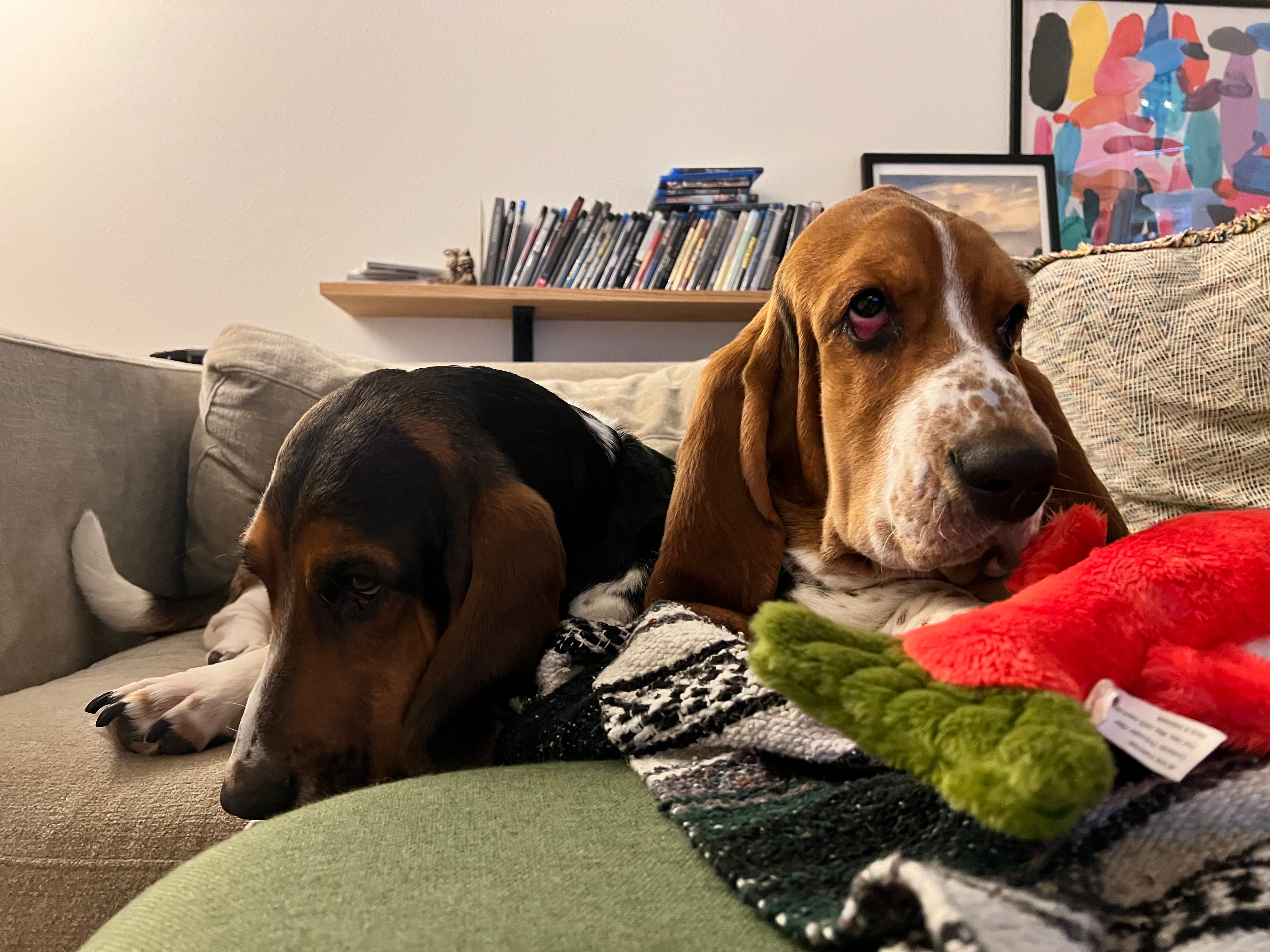
And so once again I lacked the mental capacity for a mid-month newsletter. But in between runs up to the Canadian pharmacy (where her meds are significantly cheaper) I’m back with an installment of the questions and topics we circled in classes this month. Since November feels like the real start to the holiday whirlwind, the broad theme this month was community.
It’s easy to get swept up in the spectacle of the holidays and lose sight of what else they offer: a chance to recommit to our bonds and celebrate one another, to take stock of what we can offer and what help we may need from each other, a chance to ensure we all have what we need to see each other through the long, dark months ahead.
We came at this from a few different angles, which I talk about a bit below. I also got to lead an extended restorative class with a full yoga nidra practice. I’m hoping I can make it a semi-regular offering because it was pretty dreamy!
The playlist
To set the vibe as you read: Regular class playlist | Restorative + Nidra playlist
Weeks 1 and 2: Metta Meditation (aka Loving Kindness)
When I was first introduced to this style of meditation I found the name “Loving Kindness” a little ooey gooey for my liking but I couldn’t deny the way it made me feel.(Although I was relieved to learn I could call it “Metta meditation” instead.) Over the years it’s become a favorite. It’s meant to expand your container for compassion, both for others and yourself. The idea of radical compassion (and radical acceptance) is a recurring project for me and I’ve found a metta meditation practice really does help. It helps me be gentler with others and understand them more clearly and it helps keep my own heart from hardening when all I want to do is turn away from the world.
So we started class with a brief meditation, silently repeating, “May you be happy, may you be healthy, may you be free” as we brought to mind someone we find easy to love, then someone we feel neutral toward, then someone we find it difficult to love, and finally toward ourselves. At the end of class we came back to it and directed those same well-wishes toward the others in the room and gradually expanding it outward from there, ending with “May all beings everywhere be happy and free.”
I asked students to notice the way this felt physically, mentally, emotionally, and energetically. I asked if they could maintain a sensation of openness and ease. I asked if they could extend compassion in the way we hope to extend love: freely, without demanding or expecting it be returned, sometimes knowing full well it won’t be. But I also reminded them that some days it’s easier than others, some days it feels impossible. We can’t expect it to always feel easy and good and simple. Life is a lot more complicated than that. That’s why we practice.
Weeks 3 and 4: The Golden Thread
I was first introduced to this idea by one of my own teachers, Anna. “There’s a concept called the golden thread,” she writes, “and it’s a beautiful image of how we are connected, student to teacher, teacher to teacher, by this golden thread of the lineage that conveys these teachings. It’s like the most sacred and beautiful version of the telephone game.”
I was thinking about this idea of the golden thread not just as a symbol of lineage, but of community. Community as tapestry, community as safety net. I was thinking about it as the way we tether ourselves to each other and that each time we come together to learn or create or work or practice or worship or aid, we form a new tie and the tapestry grows stronger, more complex.
And I was thinking about this when I came across Skye Pennant’s note about visible mending and I thought, how beautiful. And so we also talked about the golden thread as a way of celebrating the hard work of communal mending. Not in a way that tries to hide or deny damage done, but in a way that purposefully calls attention to the repair. Because to repair something at all is an act of love and hope for the future, it means the thing is worth the effort. And this, I think, is just the work of living.
Week 5: Giving & Receiving
What can you give freely? What can you accept freely? These were the main questions I posed in the final week of the month. But I started these classes with a whole bunch of other questions, meant to get people to look around the room a little and remember that their individual mat isn’t a walled off space. Some of the things I asked:
Who was born in Bellingham? Who’s lived here more than 5 years? Less than 1?
Who speaks more than 1 language? More than 2? More than 3?1
Who’s a good cook? Who’s a good eater? Who’s a picky eater?
Who likes to dance? Who has two left feet? Who has two left feet but still likes to dance?
Who’s an artist? A scientist? A poet? Who’s work is very physical?
Who owns their own business or is self-employed?
Who’s a gardener? Who has chickens at home? Goats?
Who’s an only child? Who has 4 or more siblings?
Who has no tattoos? Who has tattoos? Who still hides their tattoos from their mom?
Now eyes closed, no raising hands, just feeling your response and the energy in the room: who’s had a big win recently, who’s celebrating a good year? who’s navigating a loss or a tough time? who’s got big dreams and ambitions for 2026? who’s searching for some big answers? who’s searching for a little slice of peace and quiet? who needs more than they can give today? who can give more than they need?
Rather than a Metta meditation this week I asked students to sit with eyes closed and hands resting in their lap, palms up. In one hand imagining those gifts they have to give, the things they have to offer. The other hand empty and ready to receive whatever it is they need most. I asked them to think about how the hands represent our ability to reach out and touch the world, touch each other, and thereby remind us that these are active practices that we take with us when we leave the studio.
Physical sequence
We played with binds this month to represent the way we, by virtue of being part of a community, are bound to each other (I’m not above corny puns!). It gave us time to reflect on how sometimes that means weathering discomfort and to notice the balance it requires between protecting ourselves and willingly opening ourselves; restriction and expansion; safeguarding and vulnerability.
Mantra
lokah samastah sukhino bhavantu
may all beings everywhere be happy and free
That’s all for this month. Send Marge some good healing vibes and we’ll catch you next time <3
The most we got was 5!
Awwww its beautiful.