
Embracing Darkness
What I talked about in class this month

Hi, it’s been awhile. My last post was my February roundup when I said I’d be taking a “brief” pause for “a couple months”. It’s been a little longer than intended.
We’re finally exiting the puppy fugue state. Margie, said puppy, is now almost a year old. We figured going from one dog to two would be no big deal. HA! All my plans for the year, all the ideas I had for this blog, all my routines (the very foundation of my mental health) evaporated in a cloud of dog farts. She nearly broke me but we’re in a good place now. I love her. Plus she’s pretty cute and Otis has finally (mostly) accepted her into his heart which has made everything easier.


Marge aside, we’ve been busy! A steady stream of visitors, trips home, seeing Oasis (!), a crazy stretch at work (blah blah), and of course the onslaught of world and national events. Every time I sat down to write I felt entirely not up to the task. But my brain is coughing and sputtering back to life.
I was recently offered a regular class at the studio I’ve been subbing at for the past year. I wasn’t sure if I’d ever teach again when I took a break in 2020, but I’ve been loving this return. I didn’t realize how much I missed it and how big of a creative outlet it is for me. So while I may have been writing less, a lot of that same energy has still been at play.
Now that I’ve been reminded just how important this part of my life is, I feel a strong need to protect it. That means taking a more deliberate approach to teaching this time around: Each month I have one general theme, one sequence, one playlist, one mantra. Before I felt like I had to offer something different in every class, I was so worried about boring students. I didn’t expect that from my own teachers so I don’t know why I expected it from myself. So far this approach has been working pretty well.
No promises, but I thought when it felt right I’d turn my month of teaching into a newsletter. Of course now that my brain is functioning again I have about 500 different ideas for regular features and mini-projects I want to take on, but I’m trying not to get ahead of myself here (though I do have something almost ready to launch, but that’s for later). So let’s just start with this.
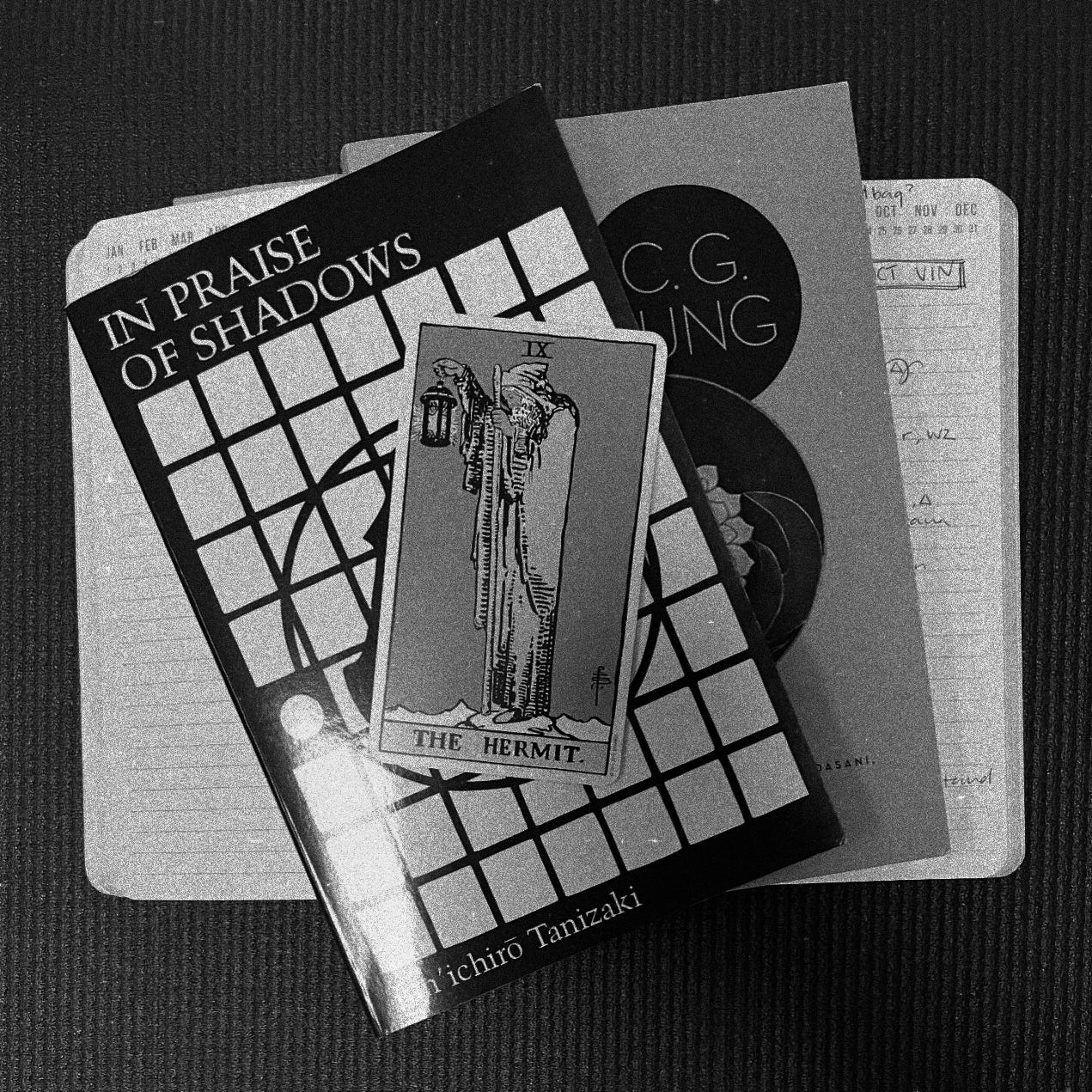
October: Embracing Darkness
(This theme is extremely my shit, full of ideas that I spend most of the year circling so most other months probably won’t be this extensive.)
The playlist
If you wanna listen as you read
Week 1: In Praise of Shadows
I used Jun’ichirō Tanizaki’s love letter to pre-electricity Japan, In Praise of Shadows, as our jumping off point. Tanizaki is a connoisseur of shadows and I like to read him as we shift into the season of longer nights. I love how he writes about darkness, making the case for an intangible, essential something that dwells in shadow. “Were it not for shadows,” he argues, “there would be no beauty.” Shadows contain the essence of mystery, they’re something to be defended and cherished. When we chase them away we, “leave the road we have followed for a thousand years,” and we lose something fundamentally human, something deep and ancient.
I read this passage in class:
I have written all this because I have thought there might still be somewhere, possibly in literature or the arts, where something could be saved. I would call back at least for literature this world of shadows we are losing. In the mansion of literature I would have the eaves deep and the walls dark, I would push back into the shadows the things that come forward too clearly, I would strip away the useless decoration. I do not ask that this be done everywhere, but perhaps we may be allowed at least one mansion where we can turn off the lights and see what it is like without them.
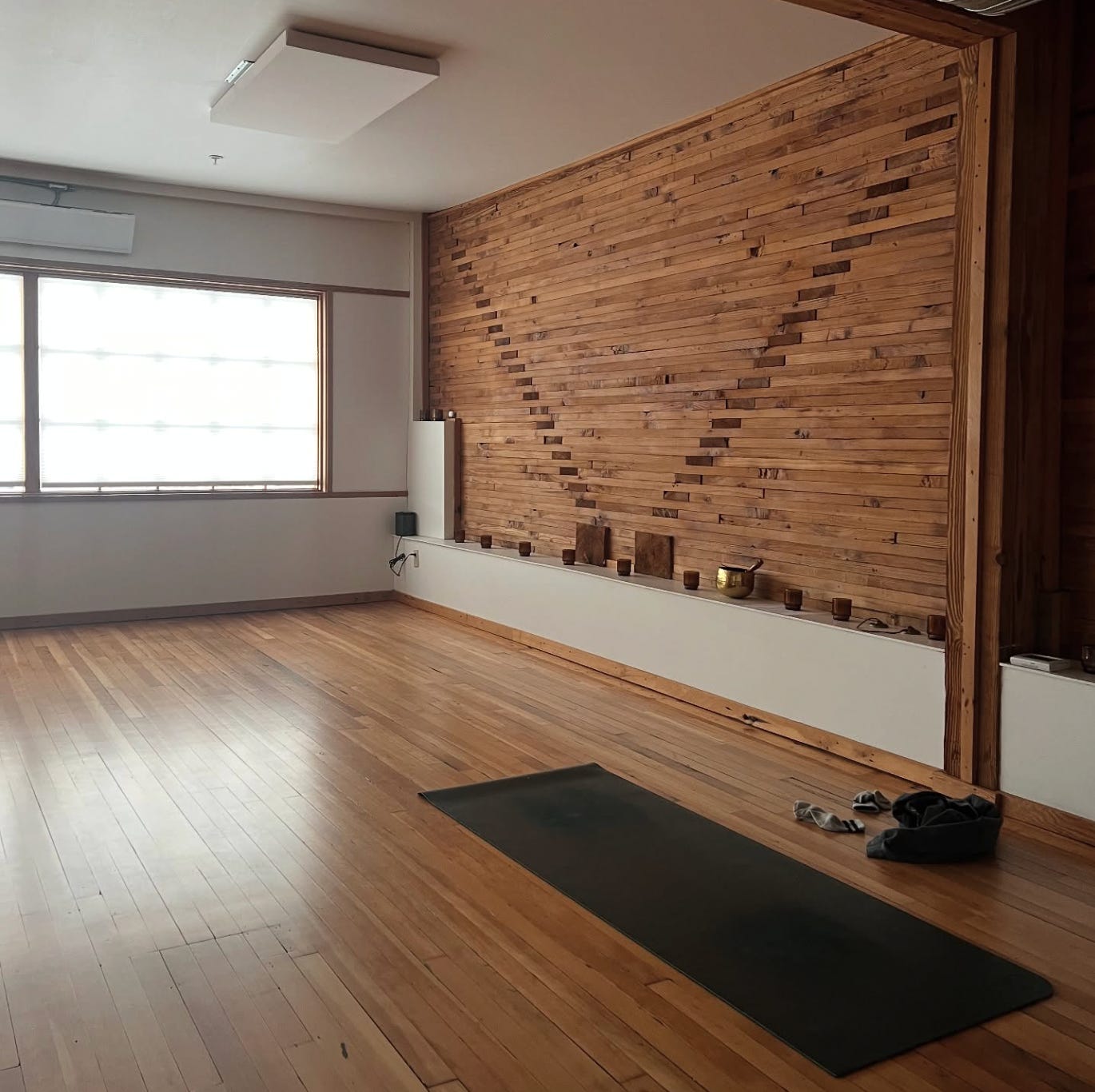
The studio was our darkened mansion this month.
I didn’t read this one in class but I love it — the atmosphere, the eerie vibe! — so I’m sharing it here:
I blink in uncertainty at this dreamlike luminescence, feeling as though some misty film were blunting my vision. The light from the pale white paper, powerless to dispel the heavy darkness of the alcove, is instead repelled by the darkness, creating a world of confusion where dark and light are indistinguishable. Have not you yourselves sensed a difference in the light that suffuses such a room, a rare tranquility not found in ordinary light? Have you never felt a sort of fear in the face of the ageless, a fear that in that room you might lose all consciousness of the passage of time, that untold years might pass and upon emerging you should find you had grown old and gray?
Week 2: The Hermit
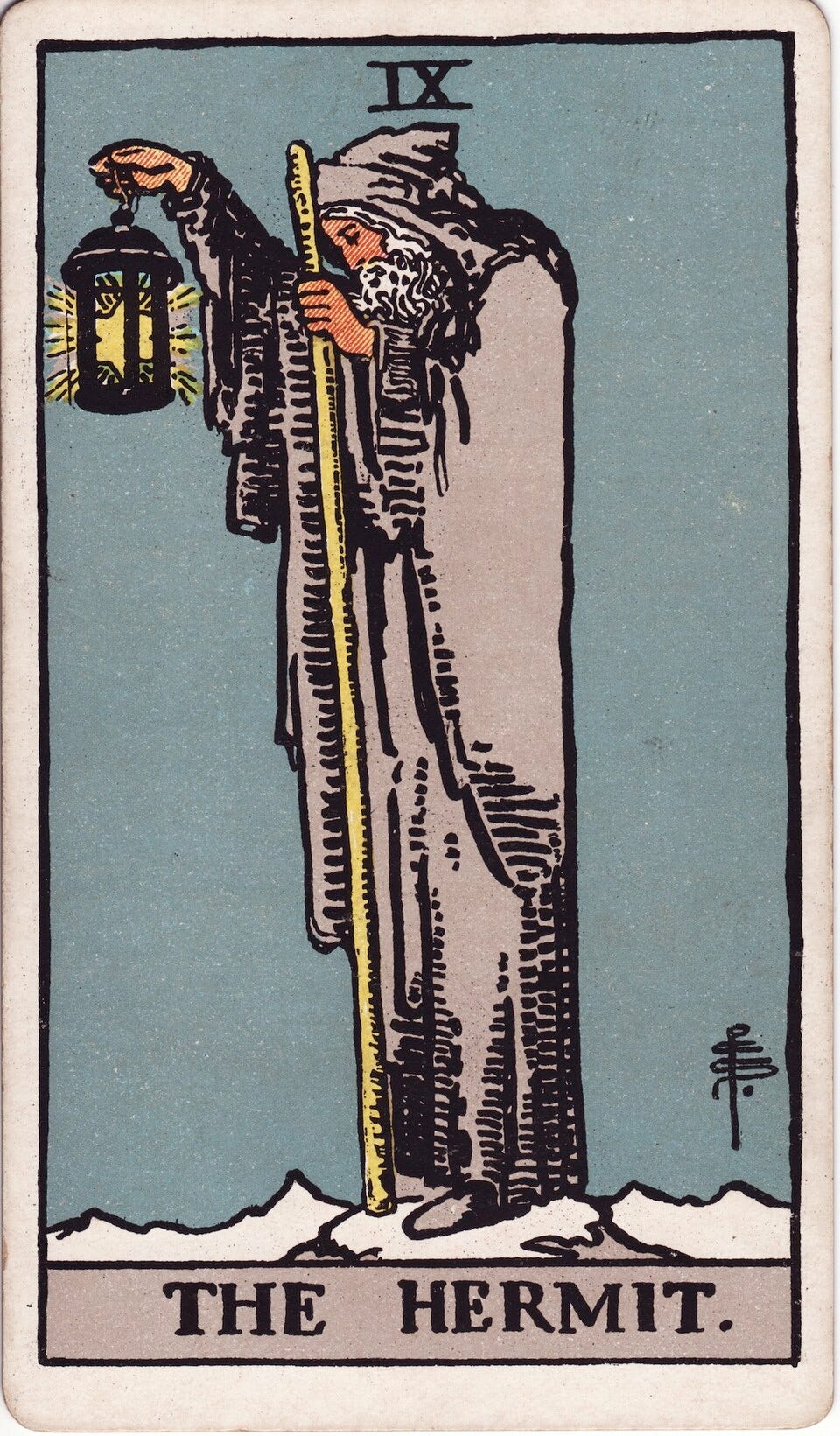
From here we moved on to the archetype of The Hermit. This was my favorite week. I introduced the Hermit through the Rider Waite illustration but invited students to think of it as more of a comparative lit or art history exercise if tarot cards triggered a woo woo allergy. I used Rachel Pollack’s writing in Seventy-Eight Degrees of Wisdom to introduce it:
The European version of a yogi ascetic, he demonstrated the possibility of approaching God through personal experience. People often looked upon the hermits as living saints, and attributed magic powers to them, in the way that yoga disciples will tell wonderful stories about their masters.
She goes on to talk about how this figure pops up across story telling traditions and is often vital to a hero’s success by gifting them a talisman that will serve them in a moment of great need or some wisdom that will aid them on their journey to enlightenment. The Hermit may also ask us look inward and embark on a spiritual journey of our own, a journey that may result in our return to the world with some hard-earned wisdom to share with those who come looking.
We talked about the symbolism of the card — the way the Hermit is equipped for the journey ahead with his staff and lantern, the way he seems undaunted by the mountains in the distance. He represents a call to action which, paired with his solitary nature, signals that each of us must walk our path alone, that we alone can walk it. And while this call to retreat from the world and explore this strange, midnight terrain may seem frightening, it also promises rewards. As the anonymous author of Meditations on the Tarot puts it:
There is no need to take pity on him. For he has his joys, and these are intense. When, for example, he meets another itinerant hermit on his way, what joy and what happiness there is in this meeting of two solitary travelers…
…Then there are the joys of profound silence, full of revelations, and those of the starry heaven, whose solemn presence speaks in the language of eternity, and the joys of the constellations of stars, and those of thoughts, and those of breathing air full of spirituality! No, one need not take pity on the Hermit.
We also did a brief visualization meditation, picturing our own midnight terrains: the landscape, the horizon, the feel of the air around us, the land beneath our feet. Noticing how it felt, this call to action, this request to step onto the darkened path. We pictured what we’d need. We noticed other points of light, bobbing slowly in the distance: others on their own paths, others we may encounter and learn from and help along the way. But only if we’re brave enough to begin.
In classes during this week I shared this poem during savasana:
Let This Darkness Be a Bell Tower
Quiet friend who has come so far,
feel how your breathing makes more space around you.
Let this darkness be a bell tower
and you the bell. As you ring,what batters you becomes your strength.
Move back and forth into the change.
What is it like, such intensity of pain?
If the drink is bitter, turn yourself to wine.In this uncontainable night,
be the mystery at the crossroads of your senses,
the meaning discovered there.And if the world has ceased to hear you,
say to the silent earth: I flow.
To the rushing water, speak: I am.— Rainer Maria Rilke
Week 3: Jung and the Shadow
From here we turned our attention to what we may encounter out there in the dark if we answer The Hermit’s call. For this I drew on Jung and the shadow — the stranger within, the self denied, the parts of ourself we push down for one reason or another — and how this could be a version of the more familiar concepts (in a yoga class at least) of self-study grounded in radical compassion and radical acceptance.
I grabbed The Undiscovered Self for this week. I was tempted to read a solid 3 pages where he goes deep on how, “none of us stands outside humanity’s black collective shadow,” and, “one can no longer avoid the realization that evil, without man’s ever having chosen it, is lodged in human nature itself.” But ultimately I decided that could be a little much for people who just wanted to breath and stretch and escape the hellscape of the current news cycle,1 and so instead I summed all that stuff up and read a line from a few paragraphs later where he says, “Where love stops, power begins, and violence, and terror.”
Because yes, even if it’s frightening, even if we’d rather not, we can understand this exploration of the ugliest parts of ourselves (the parts we’ve wrongly convinced ourselves are ugly and those that truly are ugly) as an exercise rooted in love. And we can understand that this too is a call to action, one we have a duty to answer.
I asked: What parts of yourself, big or small, scare you? In what ways, big or small, might your life be different if you weren’t afraid? How would it feel, just for an hour, to set the fear aside and bring these parts into the light? How would it feel to admit imperfection and love yourself anyway? What would you learn if you listened to this other self, just for a moment?
Savasana poem:
Love After Love
The time will come
when, with elation,
you will greet yourself arriving
at your own door, in your own mirror,
and each will smile at the other’s welcome,and say, sit here. Eat.
You will love again the stranger who was your self.
Give wine. Give bread. Give back your heart
to itself, to the stranger who has loved youall your life, whom you ignored
for another, who knows you by heart.
Take down the love letters from the bookshelf,the photographs, the desperate notes,
peel your own image from the mirror.
Sit. Feast on your life.— Derek Walcott
Week 4: Basking in Mystery
And finally we came to bask in the unknowable, the dark depths of true mystery. I asked students to call to mind the questions they most want answered, the questions they find themselves coming back to again and again over the years. I asked, What if it’s unanswerable? How does it feel to say, “I don’t know” and let that be the end? How does it feel to hear, “I don’t know” and let that be the answer? Can you accept that? And even if you know you’ll never get answers, is there still something valuable to be gained in the act of searching?
We talked about this not in an “ignorance is bliss” way, but in the sense that reality is often too big, too weird, too unknowable to satisfy our desire to know. Same for other people. Same for ourselves! So what the hell do we do with that? Try not to freak out, try to view mystery as a source of peace and sublime wonder and — possibly — divinity. And then we’re back to Tanizaki: darkness and mystery as something to be cherished, not chased away. The spotlight of our conscious mind, so desperate to illuminate every nook and cranny in its search for answers, fended off for a little while longer. The mystery hums along.
Savasana poem:
Of Rain and Air
All day I have been closed up
inside rooms, speaking of trivial
matters. Now at last I have come out
into the night, myself a centerof darkness.
Beneath the clouds the low sky glows
with scattered lights. I can hardly think
this is happening. Here in this bright absenceof day, I feel myself opening out
with contentment.
All around me the soft rain is whispering
of thousands of feet of airinvisible above us.
— Wayne Dodd
Mantra
This month we worked with what may be my favorite mantra. And it fit the murky vibe of seeking in shadows, awakening through darkness.
Oṁ asatomā sad gamaya
tamasomā jyotir gamaya
mrityor mā amritam gamaya
Oṁ śhānti śhānti śhāntiḥFrom the unreal to the real, lead me
From darkness to light, lead me
From death to immortality, lead me
Om peace peace peace
Sequence
The physical sequence involved some twisting and some transitions that were meant to feel a little off kilter, a little topsy turvy, inviting students to get comfortable in unfamiliar territory. We made physical contact with the backbody, which yoga teachers sometimes talk about as being associated with the unconscious mind (since the eyes and sight are so associated with the conscious mind and what we see is often just the front side of the body). At times, we moved with less visual input — keeping the studio lights low and closing the eyes to tune into other types of feedback in a familiar pose or transition. It always excites me as a teacher when I look around and everyone’s doing something a little different. By the end of the month I really saw that happening. It makes me feel like I did my job of creating an environment of exploration and introspection. I love teaching 🥲
Ok that’s all for now, who knows when the next dispatch will come. Maybe next week, maybe next June, who can say!
Take care of yourselves <3
Although…has there ever been a better time or a clearer need for us to confront this!?!
I really loved all the poems that you chose. This sounds like a really great class!